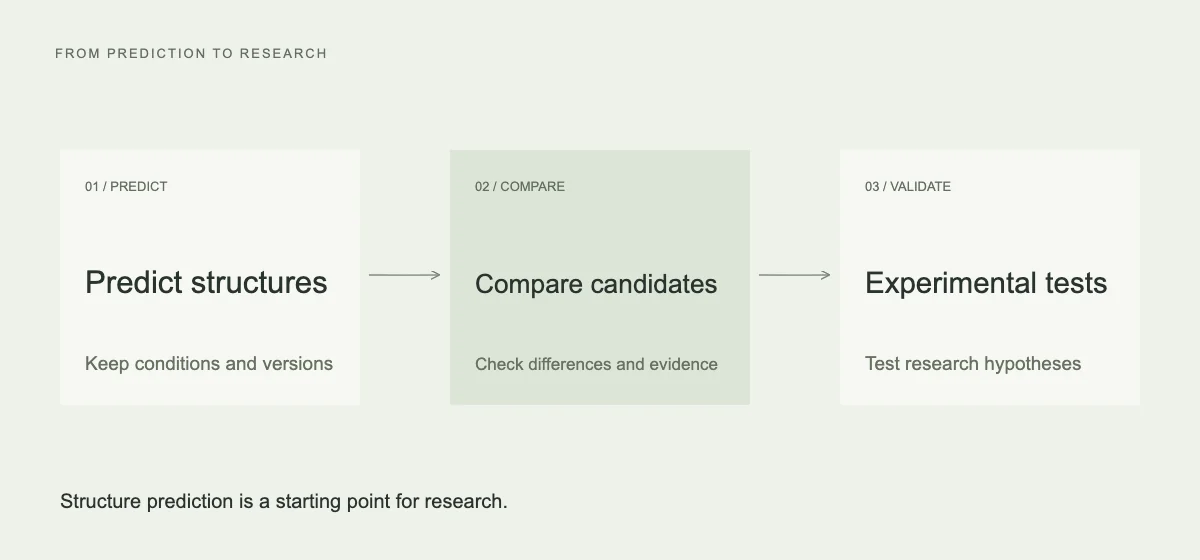
A beautiful molecular image can appear to sum up progress in structure prediction. It presents an answer, but a researcher’s questions often remain: why do these candidates differ, what deserves further inspection and what should the next experiment test?
When reading AlphaFold 3, we focus on how that change affects research. The broader the tool’s coverage, the more teams need a way to place computed structures back into their originating task. Otherwise outputs accumulate without making selection reasons any clearer.
Structure prediction changes what can be compared
Published in May 2024, the AlphaFold 3 paper predicts complexes containing proteins, nucleic acids, small molecules, ions and modified residues within one framework. It expands the molecular types that can be modelled together and therefore the questions researchers can ask.
The appeal is examining molecular relationships together. For a particular study, a predicted structure supplies information to interpret and validate. Whether a candidate shows the expected properties experimentally has its own evidence requirements.
An interface can conceal an important distinction: a fully displayed structure does not mean every part is equally reliable. The paper discusses confidence assessment and generative models producing plausible-looking structures. Uncertainty information needs to accompany the structure when it reaches users.
What a prediction record should contain
Suppose a team compares two candidate groups. Two files and a comparison image are a convenient delivery, but insufficient to explain differences. If inputs, settings or model versions changed between calculations, the meaning of the comparison needs review. Workflow design must handle this explicitly rather than relying on filenames to happen to capture it.
Organise a calculation as a reviewable research record: which question it addresses, source inputs, cleaning steps, configuration, output location and who has assessed it. Users should return to these directly from results rather than search a chat history.
Retention granularity involves trade-offs. Keeping necessary inputs and run settings creates a different maintenance burden from endlessly copying all intermediate files. At project start, agree what supports reproduction, what explains outputs and what can be removed after a defined period. Those choices affect whether the tool remains usable months later.
In collaborative research, negative results also need to be searchable. Why a candidate was abandoned can matter more than its previous ranking. Retained reasons tell newcomers which attempts happened and which questions remain open.
Which difference should the next experiment investigate?
Once calculations enter discussion, the product should help researchers ask more specific questions: did input changes cause candidate differences, does a critical region need other evidence, and can current results narrow the next comparison? These are application-design decisions, not questions AlphaFold 3 has already answered for every research task.
Validate around decisions too. For a tool organising leads, check accuracy and missing critical information. For screening support, compare with existing samples and independent methods and examine how errors affect selection. Computation speed alone does not establish improvement of the whole task.
Research software should leave a state in which work can continue: researchers know why they kept a candidate, can return to its basis and know where the next evidence should come from. Structure prediction becomes one part of research, with subsequent judgements still open to questioning and revision.