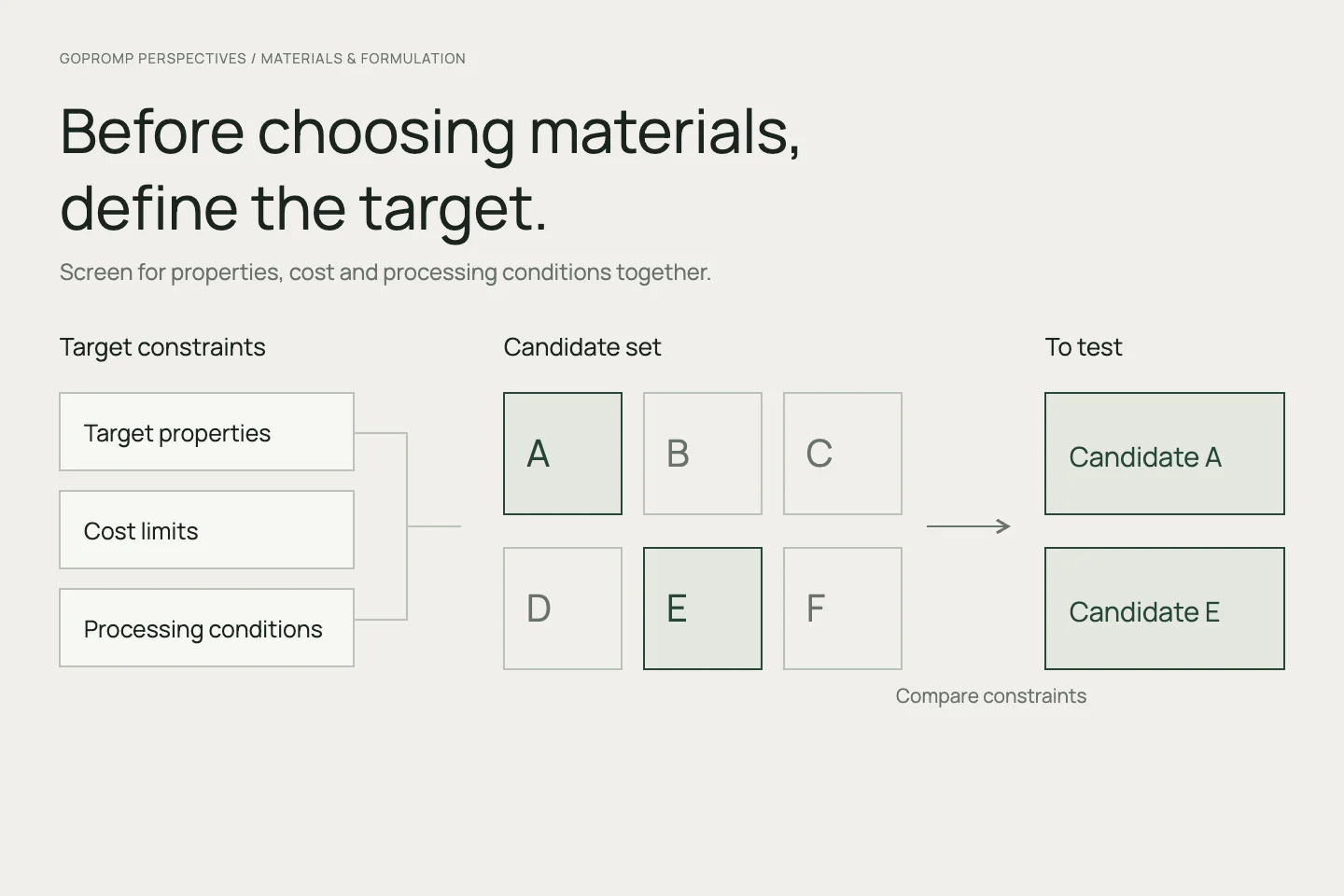
“Find a better material” is not enough to begin computation. Higher heat resistance, lower weight and lower cost may require different formulations or structures; the same property can change with measurement conditions. Clarify these requirements first to establish a basis for comparison.
Turn a target into conditions
List mandatory conditions before desired improvements. A thermal-management task, for example, may need conductivity over a specified temperature range alongside weight, processing and procurement requirements. The R&D team confirms hard thresholds and negotiable trade-offs.
Sources matter too. Distinguish properties from literature, supplier information, calculation and measurement. Data with different units, sample handling or methods cannot simply enter one ranking. Unsupported inputs should first be labelled assumptions.
Kemira and CuspAI’s materials announcement includes target-molecule removal, water stability, synthesis conditions and cost in the task and states that candidates proceed to further development and testing. The useful lesson is to state screening conditions and delivery stage together.
Bring candidates with their evidence
Choose a search method only after defining goals. Screen an existing library, constrain changes to an existing formulation or compare candidates using a suitable property model. Generating a new structure also requires assessing whether it can be calculated, synthesised and measured.
Each candidate should include composition or structure, calculation conditions, property evidence, unmet requirements and unknowns. State the data range supporting predictions. Outside it, request data or other checks rather than retain the same confidence.
Software can organise information, call computations and record rejection reasons. Researchers still decide which assumptions make sense and which risks deserve an experiment.
Choose the next experiment
The highest-ranked candidate may not deserve the first test. When options are close, an experiment that distinguishes them can be more useful than repeating existing conditions. Priorities account for expected performance, uncertainty, sample difficulty and equipment.
Before testing, preserve an existing-design baseline, define measures, arrange repeats and hold out conditions or batches from tuning. Grouping depends on the domain and data structure; adjacent records from one sample batch cannot be arbitrarily split into independent evidence.
For physical work, GOPROMP can discuss software, calculation and record workflows. Preparation and testing need coordination with customer experimental teams that have suitable facilities. Confirm inputs, equipment conditions and acceptance at the start.
Return results to screening
After a test, the sample should trace to its formulation version, handling and measurements. Uncountable’s Mitra Chem case associates steps from raw materials to battery assembly with sample records. We learn from this way of tracing results back to a specific process.
When results disagree with predictions, inspect samples, conditions and calculation assumptions before choosing what to change. Retain reasons for rejecting candidates to avoid repeating the same mistake.
This is a materials and formulation collaboration direction we want to pursue. Current public projects support software construction, record-keeping and review methods; they are not materials-discovery results or evidence that we have a materials foundation model.