A round of R&D often leaves several options worth pursuing. A formulation performs better but is harder to apply; a structure is lighter but more sensitive to mounting; a channel transfers more heat but the existing pump may not supply enough flow. The team needs to decide where the next computation, fabrication or experiment belongs.
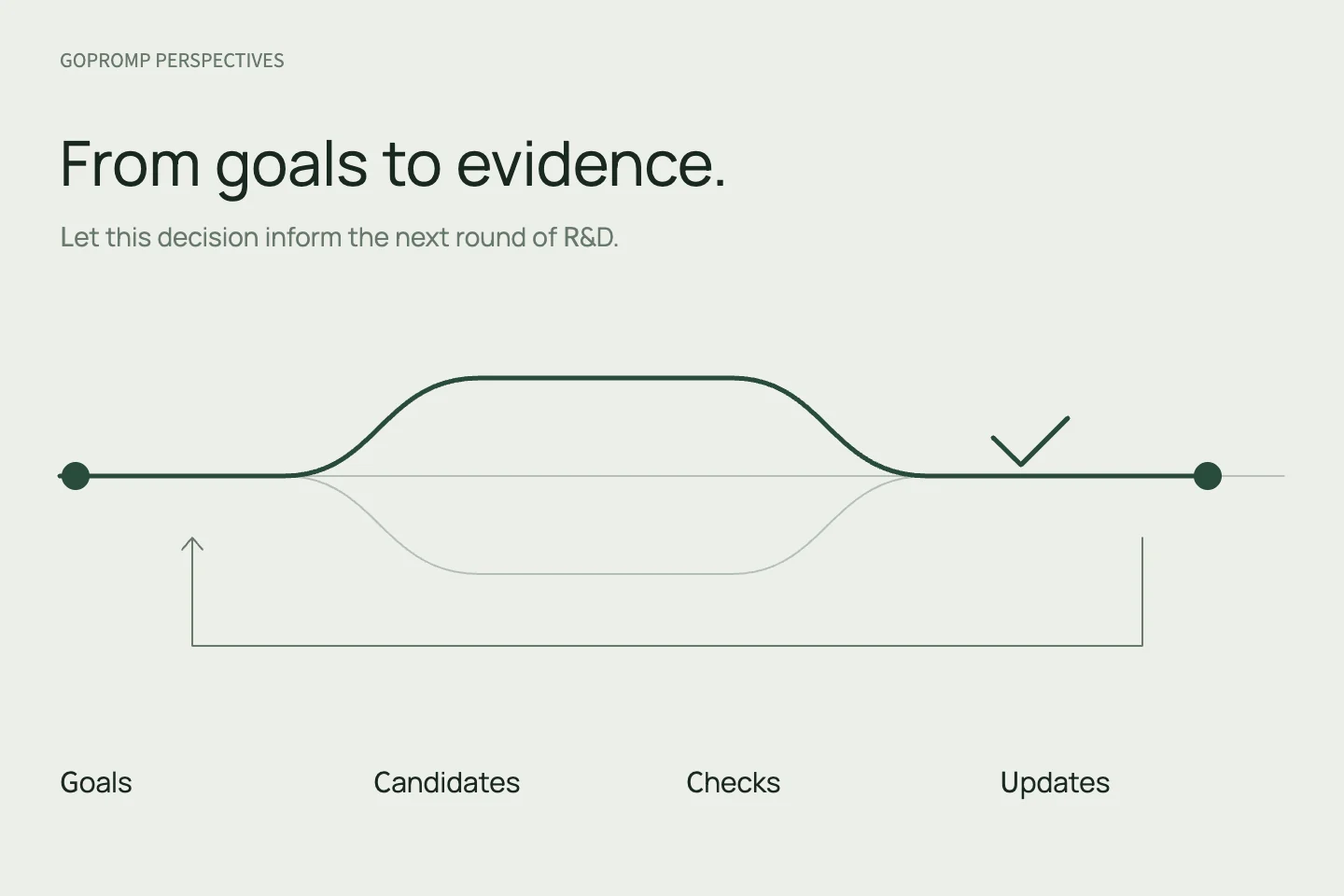
GOPROMP starts with that decision. We organise targets, domain knowledge and available tools into a specific task, let AI participate in candidate exploration, then use computation, independent checks and experiments to decide what can proceed. If results disagree, the next round may need to explain why rather than immediately propose more options.
Task goals and acceptance conditions
“Find a better material” needs a definition: which property should change, which conditions must stay fixed and which costs are acceptable? Performance, cost, processing and supply rarely reach their individual best simultaneously. Distinguish mandatory thresholds from negotiable objectives first and retain alternatives with different trade-offs.
Define this round’s scope too. Adjusting proportions in an existing material system needs different data and validation from discovering a new system. Changing a bracket with fixed interfaces is not changing the load path of an entire machine. Scope determines adjustable parameters, models, comparison baselines and who judges the result.
Define acceptance before exploration. The intended use of model-error estimates, prototype test conditions and comparison against the existing design all affect which candidates are worth proposing. When conditions change, retain a new task version so both judgements have a recorded basis.
Candidate representation and AI’s role
AI can learn relationships between parameters and behaviour from calculations or experiments to screen candidates, estimate uncertainty and plan further exploration. It may avoid a batch of obviously unsuitable designs or deliberately choose an experiment that clarifies a boundary. Those choices serve different purposes.
Domain conditions constrain the search space first. Formulation proportions must meet totals and processing requirements; geometry must preserve interfaces and assembly space; experiments depend on equipment, samples and measurement time. Encode these in candidate representations and execution rules so recommendations correspond to work that can actually be performed.
Tools have distinct responsibilities. Language models organise requirements, draft settings, call tools and help investigate logs; CAD builds geometry; solvers calculate; instruments and experimental staff obtain measurements. Software saves inputs, versions and outputs at each stage and identifies whether a result is prediction, solving or measurement.
With insufficient data, establish a starting point using domain rules, simple models and purposeful calculations or experiments. Train a more complex model only if it can improve candidate selection, rather than selecting a model architecture before understanding the task.
Recommendations and independent evaluation
Organise candidate generation separately from evaluation. After generation reports success, another program reads geometry back and checks interfaces and components. After a surrogate ranks candidates, key designs return to a solver or to experiments excluded from tuning. This catches problems outside the generation process’s own checks.
Different checks answer different questions. Geometry checks assess specified shapes and relationships; numerical checks assess stability of discretised calculations; physical experiments assess actual samples under agreed conditions. Each step retains its object and conditions, and the next addresses missing evidence.
Keep checks beyond normal cases: missing inputs, unit errors, changed interfaces, failed runs and candidates outside the observed range. A system should advance appropriate tasks and explain why current conditions do not support a recommendation.
Locating failures and limiting changes
If a cold-plate prototype is hotter than predicted, more training data may not be the right next step. Was actual flow achieved? Were the heat source and mounting the same? Are measurement locations comparable? These point to different equipment conditions, process records or model assumptions.
Separate observed differences, possible causes and collected evidence. The next experiment should distinguish key explanations: changing flow, repeating mounting or remeasuring answers different questions. If several factors must change together, limit the conclusion to that combination and retain unresolved causes.
Material and process tasks involve similar choices. A performance change can come from formulation or preparation batch; a failed experiment can reflect an infeasible candidate or incomplete execution. Decide how the data should enter the model before changing a design, adding measurements or narrowing the search.
Using results in the next round
Updates extend beyond model parameters. An assembly failure may add a spatial constraint; an operating mismatch may narrow model applicability; an untraceable measurement may change data-acceptance rules. Software needs reasons for these changes and must rerun affected checks.
Separate tuning results from final evaluation. Discuss stability through repeats, complete batches or held-out conditions within a specified range. When scope changes, redefine required validation. The team should know which conditions support its current choice and which still require work.
Delivery is organised around that judgement: editable candidates or models, repeatable runs, raw measurements and checking records, unresolved items and reasons for the next action. Different tasks can use different applications; uniform management does not require forcing them into one interface.
Applications across R&D tasks
Materials, mechanical design, thermal processes and photonic devices involve different objects, but each needs a target translated into an evaluable action. These articles examine technical choices in candidate design, experimental planning and model calibration:
- Multi-objective Formulation Search and Experimental Validation—select candidates within performance, application and cost constraints, separating formulation effects from preparation variability.
- Parametric Mechanical Design and Independent Validation—use parametric models, loads, assembly checks and prototype results together to determine the next step.
- Cold-Plate Design Optimisation Across Operating Conditions—compare channels under actual equipment conditions and choose calculations and tests that explain disagreements.
- Experimental Design and Operating Windows for Crystallisation—decide whether to keep optimising or first investigate causes within experimental budgets, batches and equipment limits.
- Inverse Design and Independent Validation of Photonic Devices—turn splitting requirements into geometric candidates, checking computation, fabrication constraints and actual measurements separately.
- Parameter Inference and Calibration for Thermal Processes—when several parameter sets explain existing data, choose new conditions and measurements that distinguish them.