Imagine engineers comparing operating settings. Every adjustment requires another calculation; waiting costs influence how many options they try and how the team discusses boundary conditions. Faster calculations can change how work is done. The question then becomes: which choices can these fast results actually support?
Neural operators matter because they provide a research route for learning physical systems’ input–response relationships. But computational speed and appropriate use still require separate answers.
Learning relationships between classes of inputs and responses
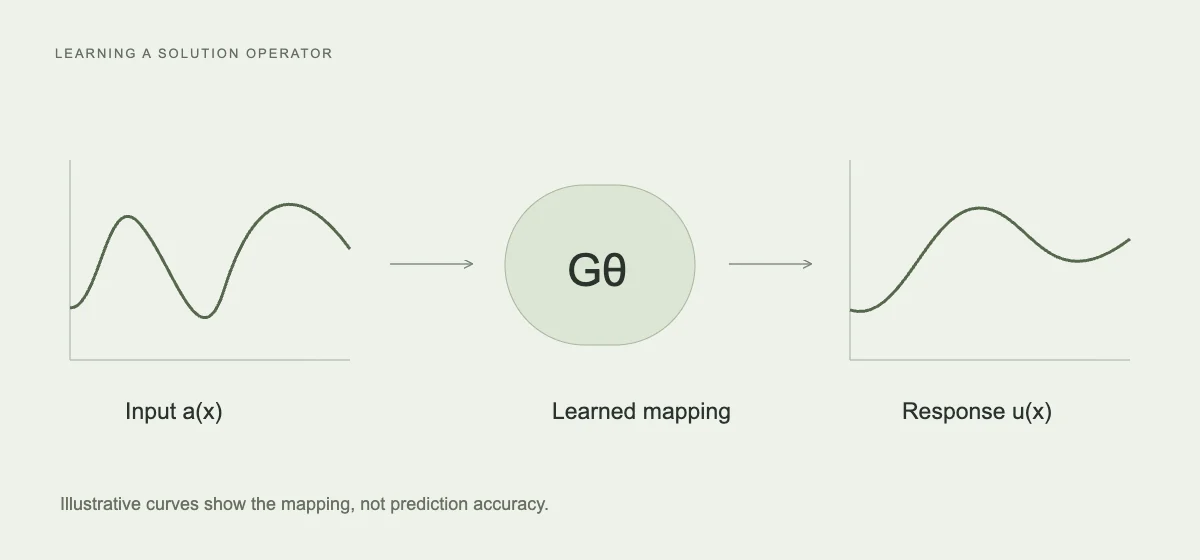
In their JMLR paper, Kovachki and colleagues study learning mappings between function spaces, calling these methods neural operators. One application learns the solution map of a partial differential equation: approximate a solution for given input conditions. The paper demonstrates prediction performance and computation speed on several equation tasks.
This shifts attention from one solution to a relationship across a class of problems. It also raises a key application question: how do current inputs relate to conditions already covered by the model? What does prior validation establish after geometry, materials or boundary conditions change? Project data and tests must answer that.
Can errors change the choice of design?
For engineering decisions, mean error does not capture everything that matters. A model can perform consistently on most samples while making consequential errors near task boundaries. Their practical importance depends on which decision they affect.
If a fast model initially screens candidates, check whether it changes their relative ranking and which conditions characterise designs it wrongly rejects. If outputs also choose operating parameters, independent validation must match that use. The same model can serve both settings, but the same acceptance conclusion does not automatically transfer.
This is a specific design recommendation, not a universal performance promise for neural operators. Define scope, organise existing simulations or measurements into a benchmark and inspect errors across conditions. When important cases are missing, adding data or narrowing use may matter more than improving an overall score.
What a digital twin needs to maintain
Computation is only one part of a digital twin. Equipment records, parameter units, component versions and model outputs need to refer to the same object. A 3D view can explain those relationships but cannot establish their correctness alone.
A useful interface lets engineers trace an anomaly to its inputs. Which model version was active? Which variables were observed and which were settings? Did update delay affect the display? Run records need enough context to answer these questions, rather than only a final curve.
Distinguish the evidence produced by different operations too. Buttons and descriptions should identify what users are checking.
| Operation | What it helps inspect |
|---|---|
| View model outputs | What prediction these inputs produced |
| Replay saved logs | How the recorded software process unfolded |
| Rerun fixed conditions | Whether a new execution reproduces existing results |
| Compare independent measurements | What bias exists under measured conditions |
These records complement each other. Replay does not automatically establish re-execution or measurement comparison. Acceptance records should state the operations actually performed.
Planning validation when computation is faster
A fast model belongs in a workflow with subsequent checks: explore candidates within the disclosed range, then send promising designs to fuller computation or measurement. Preserve selection reasons and input versions at each handover rather than transferring only an output image.
Changing conditions need an explicit revalidation path. Replaced components, new data sources or changed use may affect prior conclusions. Agree with engineers at delivery which changes require new checks.
To assess value, work backwards from a practical decision: did the system help compare previously difficult options, explain important uncertainty and retain a basis for further validation? Computational speed gets a concrete purpose through those questions.