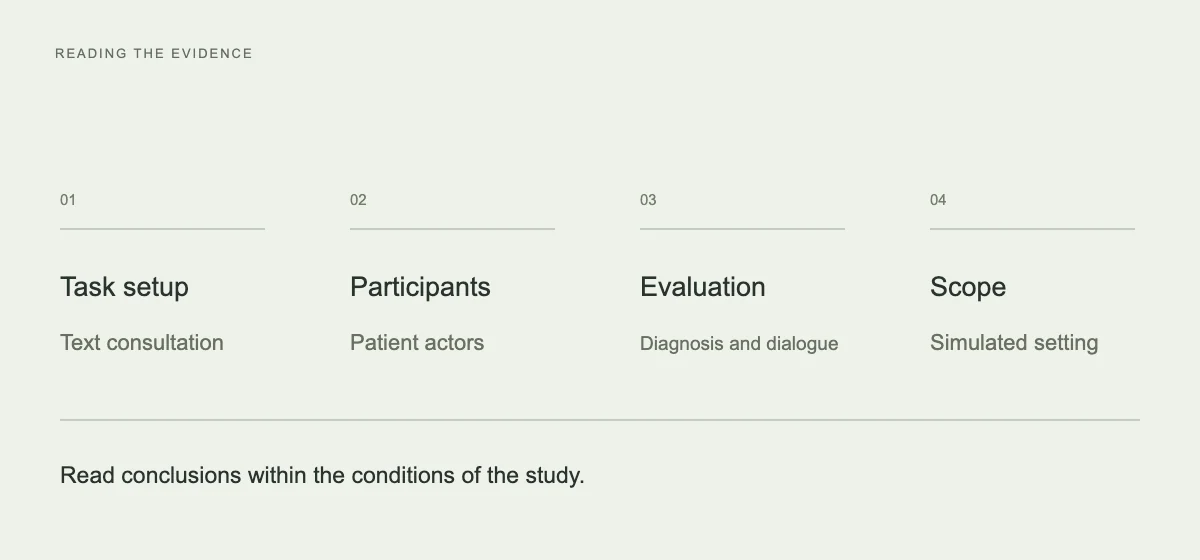
Medical AI results become easier to understand in their evaluation context. When a system improves in diagnosis or communication, ask what information it received, what task it performed and who assessed the result. Those details determine how far the conclusion can travel.
AMIE is useful to read this way. It studies multi-turn diagnostic dialogue; understanding the paper means examining both performance and the conditions that produced it.
Comparison in a text consultation
Published in April 2025, the AMIE study compares the system with primary-care physicians in a randomised, double-blind crossover study using text consultations with patient actors. It evaluates diagnosis, communication and other dimensions and reports positive results in that setting.
The authors state that synchronous text chat and simulated patients do not represent everyday clinical practice. That limitation is part of interpreting the results. Transferring performance into another environment requires new definitions of inputs, usage and evaluation evidence.
Changing use changes the evaluation question
For product decisions, first break “medical assistance” into specific tasks. Literature search needs citation checks; summaries need checks for missing critical content; study-data review needs relationships between records and versions. These tasks may share model capabilities but require different acceptance evidence.
Suppose the requirement is to turn specified documents into a summary for review. Fluent text answers only a small part of the task. Reviewers also need to identify the source of each statement, missing temporal conditions and altered expressions of uncertainty. Validation cases should cover these errors, not only whether a whole paragraph seems plausible.
The AMIE study does not directly validate that summary product. We can follow progress in diagnostic dialogue and independently validate the intended application. Keeping research and product evidence distinct makes discussion easier.
How a professional completes a review
“Keep human review” is a common requirement. To make it real, the interface must provide supporting material and clear actions. Can reviewers inspect sources, summaries and differences in one context? Do later changes trigger review again after confirmation? Can users pause and request information when evidence is insufficient?
These questions change data structures and interaction design. Confirmation should attach to a fixed version; otherwise an updated source may retain an older confirmation status. Missing information also needs explicit recording, rather than depending on reviewers remembering to follow up.
Include review operations in evaluation. If a tool saves drafting time but forces professionals to recover every source themselves, overall improvement remains unclear. Observe the complete task, including verification, revision and handover.
Errors belong in improvement records
In actual use, reported problems should trace to a specific output and its original inputs. Distinguish incomplete source material, failed retrieval, incorrect model organisation and interface-induced misreading. They need different corrections.
These records can become task-specific validation cases. After a model or workflow update, check whether known problems recur. Applications involving clinical judgement also need appropriate professional validation and review; software being live does not replace those.
AMIE gives us reason to keep following diagnostic-dialogue research and reinforces a practical application task: specify intended use and make professional review an operation people can actually complete. That establishes where the next technical advance should fit.