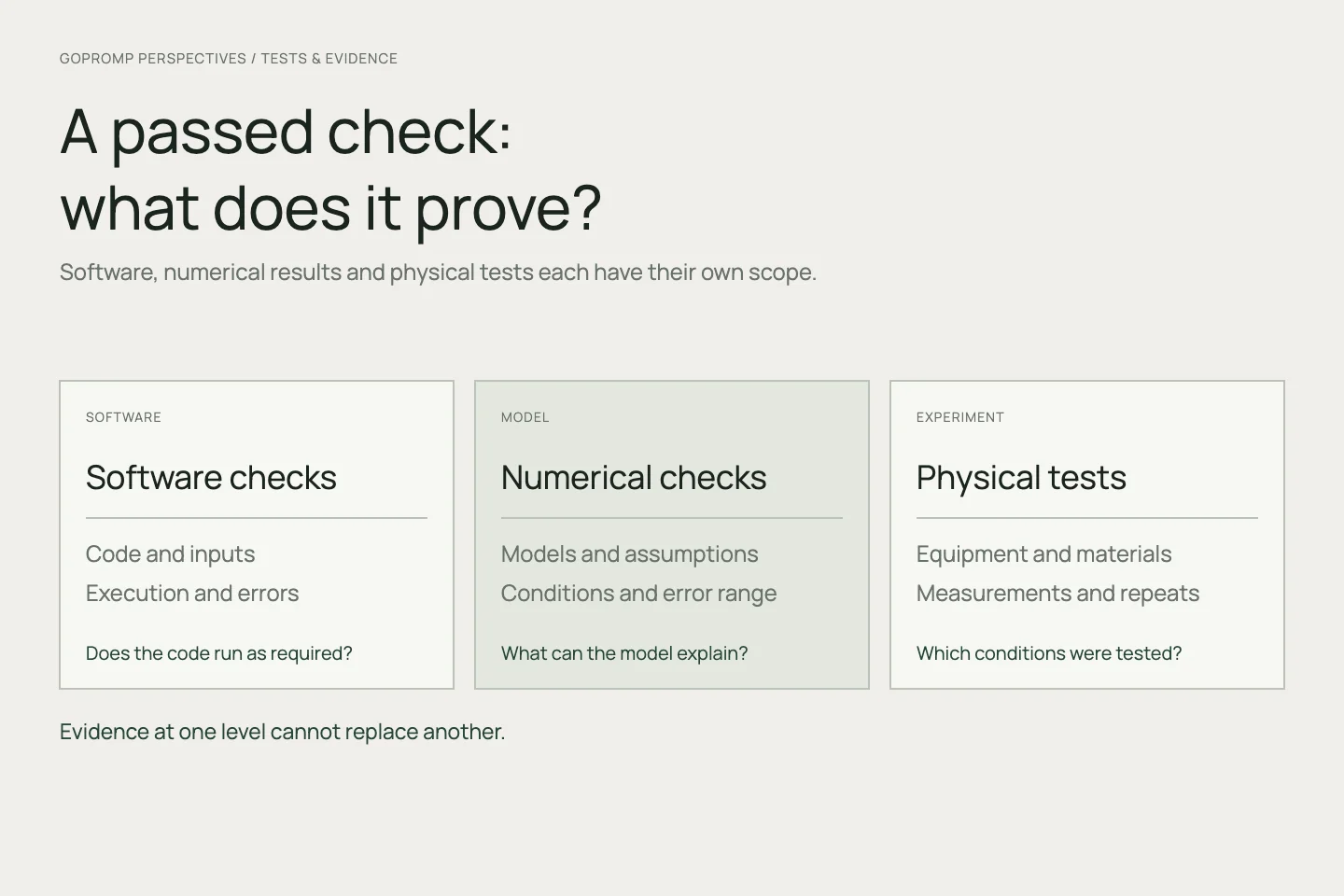
A report saying “validation passed” still needs to explain what was validated. An openable file, a repeatable calculation and working equipment are different judgements. Defining the object lets teams decide whether to manufacture a prototype, continue testing or expand use.
First check software and models
After parametric generation, read exports back to inspect geometry, dimensions and assembly. Rerun control software under fixed settings to observe inputs, states and outputs. Use independent criteria and retain versions and failures.
Software tests have a defined scope. MOTRA uses log replay to inspect recorded processes, fixed-configuration re-execution to reproduce software behaviour and geometry checks to assess models. None substitutes for vendor PLC integration, real-equipment tests or safety certification.
Ask what computation covers
Calculations support a judgement under stated assumptions. Inputs, solver settings and training and validation data need to be accessible. Predicting one condition does not establish validity at other temperatures, speeds or material batches.
PhysicsX’s glider article records design, manufacture and flight tests and explains that the model calculates longitudinal stability, while lateral stability remains to be explored. The lesson is to state model coverage separately from problems encountered in physical trials.
Outside the range, add calculations or experiments and redefine applicability. Describe stability similarly: under which conditions runs were repeated, which anomalies occurred and which boundaries remain untested.
Measurement needs its own conditions
Photonic devices illustrate this level. After a test plan is executed correctly, check device identity, instrument calibration, scan range, raw curves and fitting methods. A smooth curve alone cannot establish that a device meets design requirements.
Axiomatic AI’s AxMeasure page puts experiment planning, instrument operation and parameter analysis in one workflow and explicitly states that the web demonstration is not connected to instruments. A demo explains operations; onsite measurements produce physical evidence. Each has a purpose and should be clearly labelled.
This is also the starting point for discussing new tasks such as photonic measurement: establish available instruments, data and professionals, then decide where software should participate. This direction cannot currently be presented as completed GOPROMP device validation.
A valid workflow still needs execution
In laboratory automation, a plan may pass structural validation while samples, consumables and instrument state still affect execution. Automata’s LINQ documentation distinguishes workflow validation from successful execution. Correct dependencies and configurations support conclusions only at that level.
Delivery reports should separate software checks, computational comparisons, physical experiments and incomplete items, each with input versions, conditions, outcomes and anomalies. Suitable experimental teams conduct physical tests; within the collaboration scope, we build software, organise calculation and retain records.
Locate failures by level too. After repair, rerun affected checks and update conclusions with new evidence. The next user can then identify usable results and conditions that require confirmation after changes.